


Poultry Drinking Water Lines

Biofilm Risks, Cleaning, and Disinfection
Clean drinking water is essential for maintaining poultry health, supporting normal growth, and achieving good production performance. However, the quality of drinking water depends not only on its source but also on the cleanliness of the entire delivery system.
Water tanks, pipelines, filters, regulators, and nipple drinkers can accumulate mineral deposits, organic matter, and microbial contamination. Over time, these materials may contribute to the development of biofilms inside drinking water lines.
Without proper cleaning and disinfection, contaminated water systems can become a potential source of harmful microorganisms and compromise farm biosecurity.
Understanding biofilm formation and implementing an effective waterline hygiene program are essential steps in maintaining a healthy poultry environment.
Why Is Poultry Drinking Water Hygiene Important?
Water is one of the most important components of poultry production. Birds depend on continuous access to clean, safe water for hydration, digestion, feed consumption, and normal physiological functions.
Poor water quality may affect bird health and interfere with farm management practices, including medication and vaccination programs administered through drinking water.
Even when the water supplied to a farm is microbiologically acceptable, contamination can develop inside storage tanks and distribution pipelines.
For this reason, water hygiene programs should address the entire system rather than focusing only on the original water source.
What Is Biofilm and How Does It Develop?
Biofilm is a structured community of microorganisms that attaches to internal surfaces and becomes embedded in a protective matrix produced by the microorganisms themselves.
Inside poultry drinking water systems, biofilms may contain different types of bacteria, yeasts, and other microorganisms.
Biofilm formation generally develops through several stages:
1. Initial Attachment
Microorganisms present in water attach to the inner surfaces of pipes, tanks, and drinking equipment.
2. Biofilm Development
As microorganisms multiply, they produce a protective matrix that helps them remain attached to surfaces.
3. Biofilm Maturation
The microbial community becomes more established, and the biofilm may accumulate additional organic and mineral material.
4. Microbial Release
Parts of the biofilm may detach and enter the flowing water, potentially spreading microorganisms throughout the drinking system.
An important challenge is that biofilm is not always visible. Water may appear clear while microbial contamination remains present inside the pipelines.
Furthermore, microorganisms embedded in biofilms may be more difficult to remove or inactivate than free-floating microorganisms.
Common Sources of Waterline Contamination
Several factors can contribute to contamination and biofilm development in poultry drinking systems.
Poor Water Source Quality
Water from wells, surface sources, or inadequately maintained storage facilities may introduce microorganisms, minerals, and organic material.
Dirty Storage Tanks
Open, poorly maintained, or insufficiently cleaned tanks can accumulate sediment, organic matter, and microbial contamination.
Mineral Deposits
Calcium, magnesium, iron, and other minerals may accumulate inside pipes and around drinking equipment, creating deposits that make cleaning more difficult.
Organic Material
Feed particles, organic matter, and other contaminants may enter the water system and contribute to biofilm formation.
Inadequate Waterline Maintenance
Irregular flushing and insufficient cleaning between flocks allow deposits and microbial communities to accumulate over time.
Dead Ends and Low-Flow Areas
Sections with limited water movement may retain stagnant water and provide favorable conditions for microbial growth.
Signs That Your Poultry Water Lines May Need Cleaning
Waterline contamination is not always easy to detect visually. However, certain observations may indicate that the system requires inspection.
Watch for:
- Slimy deposits inside pipes or drinkers
- Discolored water or visible sediment
- Unusual odors
- Mineral scale around nipple drinkers
- Irregular water flow from drinking nipples
- Repeated water-quality test abnormalities
- Deposits accumulating inside storage tanks and filters
These observations do not confirm the presence of a specific pathogen. Laboratory testing is necessary to evaluate microbiological water quality accurately.
The Difference between Waterline Cleaning and Disinfection
Cleaning and disinfection are two different but complementary processes.
Cleaning focuses on removing physical deposits, mineral scale, organic matter, and accumulated biofilm material from the internal surfaces of the drinking system.
Disinfection aims to reduce or inactivate microorganisms that remain on surfaces or in the water after appropriate cleaning.
Disinfection alone may not be sufficient when thick deposits or established biofilms are present. Organic and mineral materials can interfere with disinfectant performance and protect microorganisms.
An effective waterline sanitation program should therefore combine appropriate cleaning, flushing, and disinfection procedures.
It is also important to distinguish disinfection from sterilization. Sterilization refers to the elimination of all forms of microbial life, including bacterial spores, whereas routine farm disinfection does not necessarily achieve this level of microbial elimination.
Step-by-Step Poultry Waterline Cleaning and Disinfection
A structured maintenance program helps keep drinking systems in good condition and reduces the risk of microbial contamination.
The following procedures provide a general framework. Exact concentrations, contact times, and flushing requirements must always follow the instructions of the selected product and the recommendations of a poultry veterinarian or qualified water-system specialist.
Step 1: Inspect the Entire Water System
Before starting, inspect:
- Main water storage tanks
- Filters and water regulators
- Distribution pipelines
- Water pressure regulators
- Nipple drinkers and connecting components
- End-of-line flushing points
Identify areas with visible deposits, restricted water flow, or accumulated sediment.
Step 2: Drain and Flush the Water Lines
Between production cycles, when birds have been removed, drain the system and flush the pipelines to remove loose sediment and accumulated material.
Flushing should cover the complete water distribution network, including the farthest sections of each line.
Check the flow from the drinking nipples and ensure that all sections receive adequate flushing.
Step 3: Remove Mineral and Organic Deposits
Select an appropriate waterline cleaning product according to the type of deposits present.
Mineral scale and organic deposits may require different cleaning approaches. In some programs, a suitable acid-based cleaner is used for mineral deposits, while an appropriate oxidizing or specialized cleaning product may help address organic contamination.
Always check chemical compatibility with the pipeline materials, seals, regulators, and drinking equipment.
Never mix acids, hydrogen peroxide, chlorine products, or other chemicals unless the manufacturers explicitly confirm that the combination is safe and approved.
Step 4: Apply the Appropriate Disinfectant
After the cleaning stage and the required flushing, apply a disinfectant suitable for the intended application.
The selected product must be appropriate for poultry drinking water systems and used according to its approved instructions.
Correct preparation, dosing, exposure time, and complete contact with the internal surfaces are essential for achieving the intended result.
Step 5: Flush the System and Check Water Flow
After treatment, flush the lines when required by the product instructions.
Ensure that cleaning or disinfecting solutions are removed as directed before returning the system to normal drinking-water service.
Check nipple drinkers, pipeline pressure, and water flow throughout the system.
Step 6: Refill with Clean Drinking Water
Refill the system with water that meets applicable drinking-water quality requirements.
Check the water at representative points, including the storage tank and the end of the distribution lines, to confirm that the system is functioning properly.
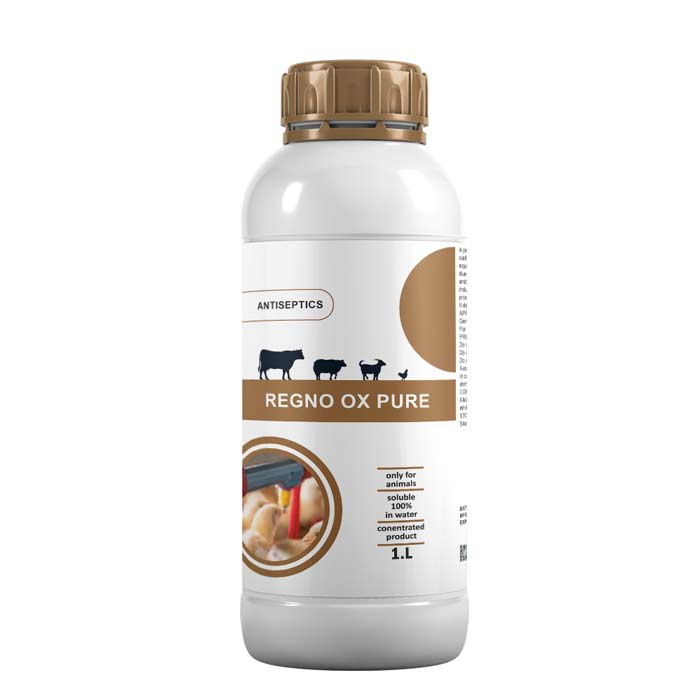
REGNO OX PURE: Supporting Poultry Water-System Hygiene
Regnovet offers REGNO OX PURE, a disinfectant formulated with hydrogen peroxide and silver nitrate for several hygiene and disinfection applications.
Its formulation contains:
- Hydrogen peroxide: 40%
- Silver nitrate: 0.05%
- Surfactants, stabilizers, and sequestrants
- Deionized water
According to Regnovet’s product information, REGNO OX PURE is intended for applications that include potable water, water systems, poultry hatcheries, animal shelters, equipment, and various surfaces.
The published application instructions list a dosing rate of 300 ml per 1,000 liters for potable water and food-transfer lines.
The product should always be used according to its current technical instructions, approved application conditions, and relevant local regulatory requirements. The listed water-system application rate should not be assumed to apply to every cleaning or shock-disinfection procedure.
REGNO OX PURE can be incorporated into an appropriate water hygiene program where its intended use is suitable.
Importantly, chemical treatment should complement regular physical cleaning, pipeline flushing, water-quality monitoring, and proper system maintenance.
Monitoring Water Quality and Maintaining Clean Water Lines
Cleaning and disinfection should not be treated as isolated activities. Continuous monitoring is necessary to evaluate water quality and identify recurring contamination.
A suitable monitoring program may include:
Microbiological Testing
Collect water samples from the source, storage tank, and representative points along the drinking lines to evaluate microbial quality.
Physical and Chemical Assessment
Monitor water appearance, odor, pH, hardness, mineral content, and other relevant parameters according to the farm’s water source and requirements.
Regular System Inspection
Check tanks, filters, pipelines, and nipple drinkers for deposits, leakage, restricted flow, and signs of biofilm accumulation.
Between-Flock Sanitation
Clean and disinfect the complete drinking water delivery system between flocks, when the poultry house is empty.
Record Keeping
Maintain records of cleaning dates, products used, application rates, water-quality results, and maintenance activities.
Regular assessment helps determine whether the existing sanitation program is effective or requires adjustment.
Common Mistakes in Poultry Waterline Hygiene
Several management mistakes can reduce the effectiveness of waterline cleaning and disinfection.
Avoid the following:
- Cleaning only the storage tank while ignoring the pipelines.
- Applying disinfectants without removing accumulated deposits.
- Using incorrect product concentrations.
- Ignoring the required contact time.
- Failing to flush the entire system.
- Mixing incompatible chemical products.
- Neglecting filters, regulators, and nipple drinkers.
- Assuming that clear-looking water is necessarily microbiologically safe.
- Using products in drinking water without confirming that the intended application is approved.
- Failing to monitor water quality after treatment.
A successful water sanitation program requires correct product selection, proper application, and consistent monitoring.
Frequently Asked Questions
Can biofilm develop even when the drinking water looks clean?
Yes. Biofilm can accumulate inside pipelines without producing obvious changes in water appearance. Regular inspection and microbiological testing help identify potential problems.
Is flushing alone sufficient to remove biofilm?
Flushing helps remove loose sediment and suspended material, but established biofilms may require additional cleaning and disinfection procedures.
Can hydrogen peroxide be used in poultry drinking water systems?
Hydrogen peroxide-based products are used in some water sanitation programs. However, the appropriate product, concentration, exposure time, and application method depend on the specific formulation and its approved instructions.
Should waterlines be disinfected while birds are inside the poultry house?
This depends on the product and it’s approved application instructions. Intensive cleaning and shock-disinfection procedures are generally planned between flocks when the house is empty. During production, only products specifically approved for the intended drinking-water application should be used.
Does cleaning the water tank guarantee clean drinking water?
No. Contamination may remain inside pipelines, filters, regulators, and nipple drinkers. The entire distribution system must be included in the hygiene program.
Final Thoughts
Clean drinking water is a fundamental part of successful poultry production. However, maintaining water quality requires more than supplying clean water at the farm entrance.
Biofilm, mineral deposits, and organic contamination can develop inside drinking systems and compromise water hygiene over time.
Regular inspection, appropriate cleaning, effective disinfection, proper flushing, and microbiological monitoring are essential for maintaining clean drinking water lines.
By implementing a consistent water sanitation program and selecting suitable products, poultry producers can strengthen farm biosecurity and support healthier flocks.
Regnovet supports poultry health and farm biosecurity through veterinary products and specialized disinfection solutions, including REGNO OX PURE. Maintaining clean drinking water systems is an important step toward healthier birds and more reliable poultry production.